The register, the ships · Board 1
The ships
The register names 188 sailings and the vessel and master of each. Two of those vessels, the two largest carriers, were King’s ships, and their drawings survive. For the rest, hired merchantmen, no picture is known.
L’Abondance
· Lieutenant Nathaniel Phillips · 507 people in the register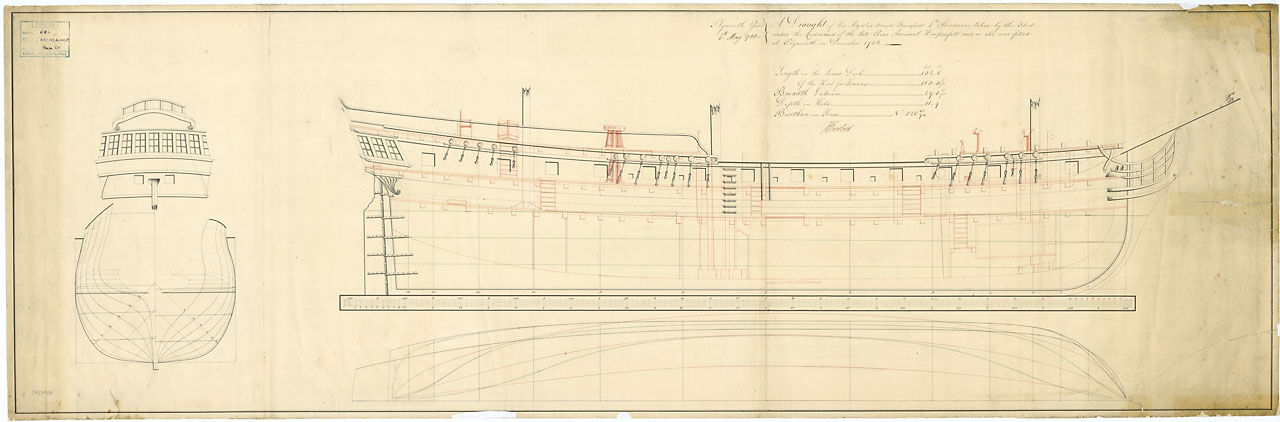
She was French, and a cargo ship by design: a naval storeship of the Baleine class, built at Le Havre and launched on September 16, 1780, about 132 feet long and 29 feet in the beam, of some 525 tons, with twenty 8-pounder guns. On December 12, 1781, in the Bay of Biscay, Admiral Kempenfelt’s squadron took her out of a French convoy bound for the West Indies, with 248 soldiers and stores aboard. The Royal Navy kept her name. She was coppered and fitted at Plymouth in the winter of 1782 to 1783, and in April 1783 she was cut down to a fourteen-gun storeship with a crew of fifty-two, under Lieutenant Nathaniel Phillips. She sailed for North America on May 23, 1783.
At New York the register has 507 people aboard her, more than any other vessel: 425 inspected on July 31, 1783, bound for Port Roseway, among them Peter Pharo of the twenty-nine and Boston King; and 82 more at the end of November, bound for Port Mouton, the last sailing in the book. She was paid off in March 1784 and sold at Deptford on April 29, 1784, for £2,200. Lloyd’s Register has her the next year as a merchantman in the Ostend trade; after 1786 she disappears.
Sources: Rif Winfield, British Warships in the Age of Sail 1714 to 1792 (2007), p. 242; J. J. Colledge, Ships of the Royal Navy; threedecks.org, ship 2853; the register (Nova Scotia Archives dataset); UELAC transcriptions of her Port Mouton voyage. Her draught: Royal Museums Greenwich, ZAZ4531.
Who sailed in her
Of the twenty-nine, Peter Pharo, 35, “formerly the property of Abraham Duryee of Millstone, New Jersey; left him 6 years ago,” by his entry. Boston King, whose memoir this site follows, was inspected for her on July 31, 1783. All 507 names in the register.
The Clinton
· Lieutenant Roger Trounce · 268 people in the register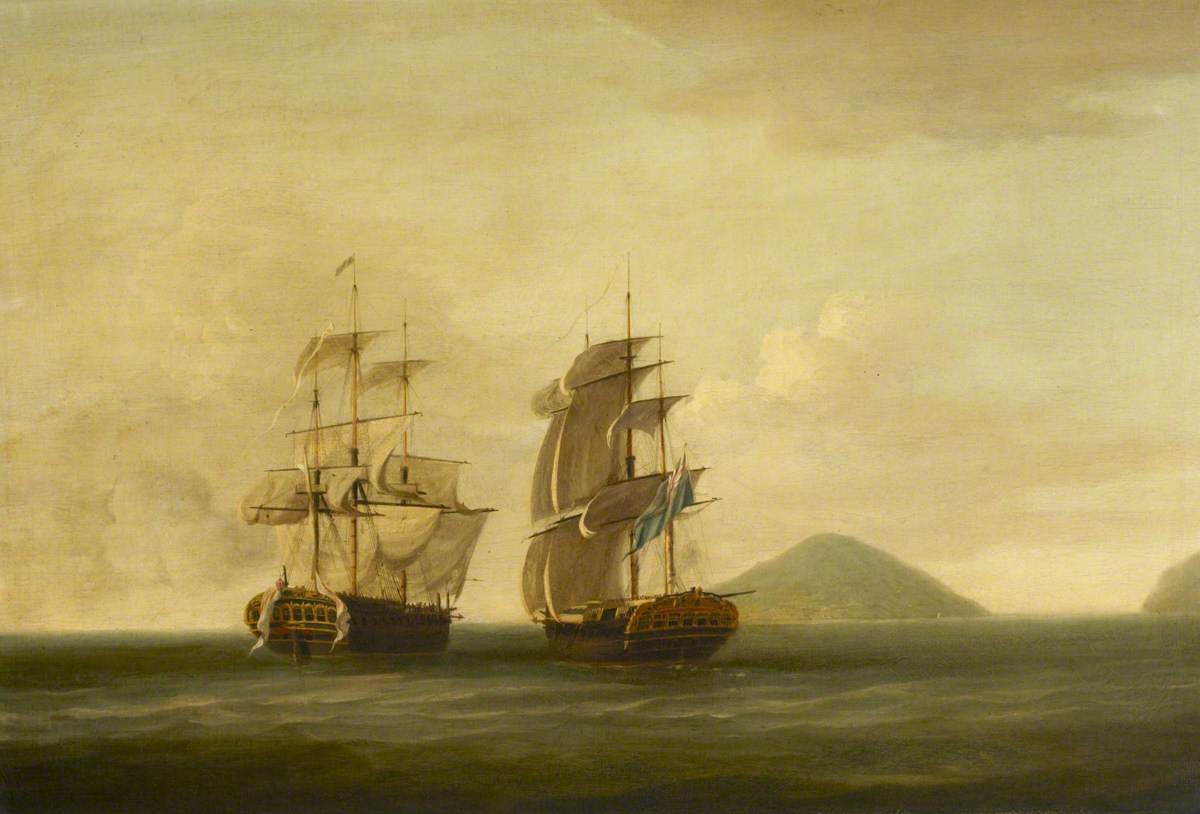
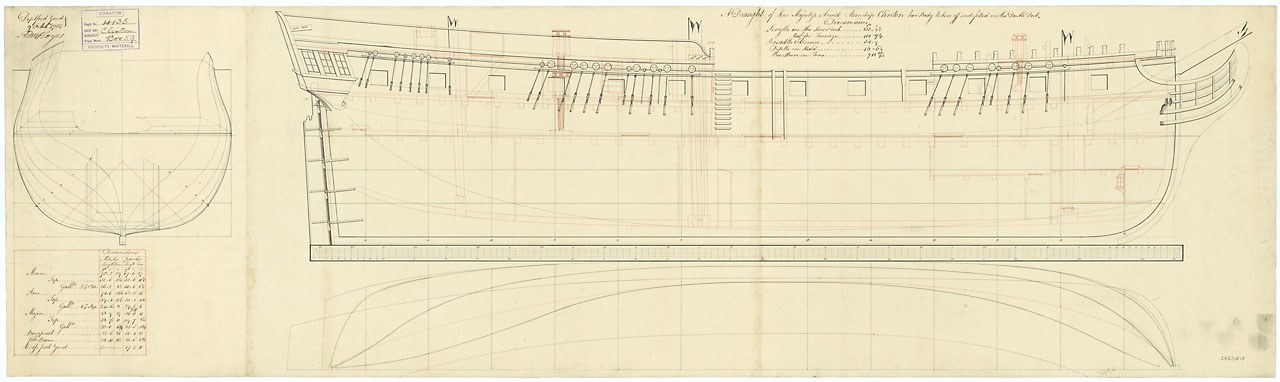
The only painting of a ship in the register shows her under another flag. She was built at Bordeaux in 1779 as the French frigate L’Espérance, thirty-two guns and nearly two hundred men. On September 30, 1780, off Bermuda, HMS Pearl, Captain George Montagu, fought her for four hours and took her; she lost twenty killed and twenty-four wounded. The Royal Navy renamed her Clinton, and in 1781 cut her down to a twelve-gun transport. Coppered and refitted at Deptford in the winter of 1782 to 1783, she sailed from Spithead on May 22, 1783, under Lieutenant Roger Trounce, and reached New York on July 3.
Black passengers mustered aboard her from July 26, 1783. The register lists 253 for “Annapolis and St Johns” in the first week of August, Susanna Vanryper of the twenty-nine among them, and fifteen more for Port Roseway in September. By her muster book she left New York on August 3, lay at Port Roseway from August 11 to 15 without landing them, put some ashore at Saint John on September 1 and the rest at Annapolis Royal on September 2. She made three voyages with Loyalists, was back at Spithead in March 1784, and was sold that July for £1,500.
Sources: Winfield; threedecks.org, ship 3624, citing ADM 6/22, ADM 34 and ADM 51; Michael S. Mallery’s transcription of her muster, July to September 1783 (The National Archives, ADM 36/9966), published by the United Empire Loyalists’ Association of Canada; the register. Her draught: Royal Museums Greenwich, ZAZ5418. The painting: Dominic Serres, 1781, National Maritime Museum, BHC0432, public domain via Wikimedia Commons.
Who sailed in her
Susanna Vanryper, 24, of the twenty-nine, bound for Annapolis and the Saint John River. All 268 names in the register.
The hired ships
· the other 186 sailingsEveryone else in the register sailed in a merchant ship hired by the Transport Board: the London Frigate, Hugh Watts; the Nesbitt; the Ranger; the Elijah; the Joseph; the Elizabeth; the Esther; the William; the Lady’s Adventure, Robert Gibson; the Mary; and more than a hundred others. The Admiralty drew plans only of the ships it owned, and nobody painted a hired collier. No drawing, model or picture of any of them is known. What we know of them is their names, their masters, where they were bound, and the people the clerks wrote down on their decks.
Most would have been ordinary North Sea and coastal traders of a few hundred tons, three-masted, bluff-bowed, built to carry coal and timber: the kind of ship the Navy hired by the hundred for this war, and the kind it bought for the Bounty and the Endeavour. The closest open model of the type is a Swedish merchant “cat” of 1759, built by the Swedish National Maritime Museums from Fredrik Henrik af Chapman’s drawings. It is a Baltic ship, not one of these, but the shape is the shape.
Turn the 3D model of a merchant ship of the period, on Sketchfab (Swedish National Maritime and Transport Museums, model by Adam de Kaminski, 2024, Creative Commons Attribution 4.0). It opens on another site; this site loads nothing from it.
No picture of the embarkation
No contemporary picture of the 1783 embarkations at New York, or of the transports at anchor off Port Roseway, is known to survive. The nearest images in time are William Booth’s 1788 watercolour of a Black wood cutter at Shelburne, on 29 Lives, and the 1789 survey of Shelburne harbour at the Nova Scotia Archives.
The ships of the twenty-nine
· fifteen sailings, April to November 1783| Sailed about | Ship and master | Bound for | People aboard | From central New Jersey |
|---|---|---|---|---|
| April 27, 1783 | Lady's Adventure Capt. Robert Gibson | Saint John River | 49 | Edmund Hill (21) |
| May 4, 1783 | London Frigate Hugh Walls | Port Roseway | 57 | William Mannan (27), James Perrow (38), Phillis Sparrow (28), Nannis Sparrow (11), Sukey Sparrow (9), John Sparrow (3) |
| May 11, 1783 | Ann Joseph Clark | Port Roseway | 40 | Abigail (35) |
| May 30, 1783 | Montague Robert Wilson | Port Roseway | 18 | John Dunn (45) |
| May 30, 1783 | Sovereign William Stewart | Saint John River | 24 | Cornelius Moss (30) |
| June 6, 1783 | Beaver Peter Parker | Port Roseway | 4 | Joseph Skinner (35), Jinnia Lynch (25), Sally Lynch (6) |
| June 13, 1783 | The Brothers William Walker | Saint John River | 6 | Cornelius McEntire (28), Lissey his wife (24), Bill McEntyre (6) |
| June 21, 1783 | Free Britain Jacob Hays | Port Roseway | 34 | Jack Richards (28) |
| July 9, 1783 | Ann John Clark | Saint John River | 5 | Peter Stogdon (23) |
| July 31, 1783 | L'Abondance Lt. Phillips | Port Roseway | 425 | Peter Pharo (35) |
| August 7, 1783 | Clinton Lt. Trounce | Annapolis and Saint John | 253 | Susanna Vanryper (24) |
| September 20, 1783 | Grand Duchess of Russia Stephen Holman | Port Roseway | 10 | Richard Sloane (40) |
| September 22, 1783 | Lord Townsend James Hogg | Annapolis Royal | 29 | Samuel Penulack (25) |
| November 14, 1783 | Nesbitt Wilson | Port Mouton | 163 | Benjamen Field (38), Ellenor Field (27), Ben Field (4), Sarah Field (2), Robert Conway (51), John Longstreet (45) |
| November 27, 1783 | Diannah William Browne | Port Mouton | 38 | Phillis Farmer (30) |
Dates are the register’s inspection dates, placed between dated entries, and approximate. “People aboard” is the register’s count for that sailing. Watch all 188 sailings.